Settling in (2008)

have a little more time today. I’ve decided to spend a couple of days in Dodoma so I can get a few things done and not feel rushed. First port of call is, of course, the internet.

I’m settled into village life now. There is nothing like a supermarket here, so working out who can supply eggs or milk or bread or buckets etc is quite a mission, but I’m pretty much there now. I am employing one semi-blind woman to do my washing and to sweep my house once a week. I pay her £1.50 for around two hours work which is something like 6 times the going rate, but this way she gets some help without it necessarily feeling like charity, and I get to be a lazy bugger! Win win.

I’ve had some strange experiences, like three nights ago I had dinner with the headmaster of the blind school and around 9pm he suggested we drive to the neighbouring village to go to a wedding party. I ended up being shpherded in and deposited on the very front row with maybe 150 locals all looking at me wondering who the hell I was as the headmaster pissed off to another bar. A guy got on the microphone and introduced me as I went redder and redder. Fortunately we didn’t stay for too long.

I bought out a portable DVD player with me on a whim and I’m really glad I did. Although I’m sleeping for around 9 hours a night, I still have quite a bit of spare time and I’ve found a place in Dodoma which sells 20 films for £3.50. I have so far shown Superman and Commando to a bunch of 4 and 5 year olds. I had to lunge forward and cover the screen during one nude scene in Commando. I think I should maybe vet the films a little better.

David is my main contact here in Buigiri. He really is a God – he thinks with a western mindset rather than an African one and if it wasn’t for him I’d really struggle out here. As I am a Msungu (white man), everyone assumes I am the answer to their problems as I naturally have inifinite resources. As such it is difficult connecting with adults as their motivations are money orientated – often for all the right reasons such as paying for their children’s education, but even so – whereas David’s motivation is helping me to help the people who really need it. As such I know who will just spend my assistance on alcohol or who has alternative sources of funds.

Corruption here is rife. It isn’t even seen as corruption, rather it’s just how things are. The headmaster of the school is amongst the worst and so I have to be very diplomatic when spending money on the children by saying things like ‘I know you are an important and busy man so I’d like to spend the money myself directly rather than give it to you’. It is quite an art. I do my best to ensure I give people items rather than the money to pay for items. I think I’ve only been caught out once so far when I gave someone from the rehab centre £10 to pay for his bus fares and accom/food for a 70km trip to see his doctor. He was meant to have gone on Saturday but yesterday he told me he can’t go until he gets money to cover his food, which is bollocks as he had more than enough.

Being a white man is a big deal here. I’ve so far had 2 offers of ‘love’ from a matron and a teacher. I’ve carefully declined. Everywhere I go I hear whispers of ‘Msungu!’ and I get to feel what it must be like to be famous. People driving along in buses will hang out the windows staring at me as they pass, some kids run up and smile at me and others burst into tears. I have acquired two shadows: Marde and Illombo who are two 5 year old girls. They hang around my house and smile at me and make fun of my Swahili. I’m generally not child-friendly, but they are cute beyond words.

Here are some pics taken in the past few days:

This is Nasson


Saeed and Thomas. I have labelled him Thomas#1 and he laughs everytime I say it.


Cinema De Tom


I’m getting 15 sets of uniforms for the kids and this is the tailor measuring them.


Moi


I got a truck load of manure for the rehab centre to help their crops in the rainy season which starts around November, but the crops usually fail so manure is very important.


I also got some sunflower seed. Sunflowers grow faster than the usual crop of maize and so can help offset poverty if the rains finish early.


This is Akiri playing a blind version of football. He seems to be very bright and is always well groomed, but his future probably isnt all that rosey cos he is extremely partially blind.


Nico and Thomas#1. Nico tends to just stand around. I want to say he stares into space, but that would be kinda dumb.


My neighbours: monkeys


Earlier today I bought (with money given to me by a poker friend) 96 sodas for the children. They had been really excited about having them all weekend. They’re only 20p each but are a big treat for them, akin to a child in England getting to go to see his football team or getting a pair of fashionable trainers.

Posted in Uncategorized | Leave a comment

Arriving in Buigiri (2008)

I am now settled in Buigiri – Ive been here for 5 days and met most of the people I wanted to see. The kids are both shy and outgoing in equal measure. The money you guys have contributed over the past couple of years has gone a long way out here. It is quite common for children to come up to me and say ‘thank you for my clothes’ or ‘thank you for my comb’ or somesuch. This has to be a quick update as time is running out in this internet cafe, but i have a Facebook group with lots of pics and vids on. Here are some pics anyhow:


This is Sara. 50quid of the last load of money that went out was enough to get her set up with her newborn baby and start a small business after she was kicked out of home. She is blind.


A broken slide I hope to get mended


Pratting about


The last load of money also bought Charles some asthma medicine. Ive got him some more today and will top him up when I leave


I planted these in 1999


A classroom in the blind school

Gotta run!

Posted in Uncategorized | Leave a comment

2006 Trip part 2

We travelled around Tanzania by bus and I think we notched up 1,200 miles. Dar es Salaam is the hub for the ‘luxury’ buses but as we were doing a triangular route we had to take a normally bus from Buigiri down to Iringa. There were over 100 people on board but luckily we had reserved seats for the eight hour trip. I did have to boot a Massai out of my seat though – any guilt I felt was eclipse by the relief to be sitting down.

Iringa is southern and central in Tanzania and is half way between several national parks. We decided we would visit Ruaha National Park rather than the famous parks of the Serengeti in the north of the country. The thinking was we would not encounter many tourists and it would be cheaper. This was indeed the case and I think we made an excellent choice.

When we arrived in Iringa we went for a drink and the owner of the café introduced us to a friend who ran a safari lodge. We ended up booking a trip for the following few days. For £125 we got transport to and from the lodge, accomodation, all meals and a car and driver for the game park. If we had been in the Serengeti then we would have paid perhaps triple this. The lodge we stayed in was fantastic. We were the only guests and we had a staff of eight looking after us. There was a pool table, a full bar and the most incredible scenery. They have only been open for a year and we received the accolade for staying up drinking the latest. Drinks in the lodge are far more expensive than elsewhere but beers still cost just 75p. We also managed to get some of the staff sloshed and before long we broke through the ‘us and them’ boundries. Our bar bill was £50 which was quite impressive, considering. The one bad momnet came when the waitress handed me a note saying ‘I give you massage, I think I love you’. Course, I can understand why she was crazy about me *ahem* but it did make things awkward.

Our lodge

I have always wanted to go on safari and it did not disappoint. We saw hundreds of Zebras and Giraffes and dozens of elephants as well as various birds, Kudu, Impala, Ostrich, Dogs, Warthog, Wildebeest and Monkeys. Alas we did not see any big cats but I was not disappointed.


Late on in the evening and feeling the worse for wear.

The following day we took our third and final bus back to Dar es Salaam. We booked our ferry tickets to Zanzibar and then spent perhaps our most uncomfortable night in Tanzania. It was very hot and humid and there was no electricity or water and our room turned into an oven. The ferry ride the next morning was delightful as we sat on the top deck and were lambasted by cooling winds.

Zanzibar is very different to Tanzania – there are more tourists and so you get plagued by people selling things or wanting you to go on a tour. Historically it was once an important jewel in Oman’s crown and it acted as a trading centre between Africa and Asia mainly for spices and slaves. The arab influence is strong. Many locals wear robes and the architecture and city layout is how I would imagine an Arabian city to be – there is a maze of narrow streets and the doors to the houses are ornately decorated.

We had two interesting meals in Stonetown. The first was in Faradhani Gardens. At dusk dozens of stalls cook up all manner of seafood. It is fantastic and very cheap. I had barracuda, shark and octopus. You eat off paper plates with your fingers and the tourists and locals mix freely. The second meal was at a place called ‘Two Tables Restaurant’. It lived up to its billing. To get there we had to walk through a family home, with the kids and grandparents glued to the television. The ‘restaurant’ was in their conservatory. There was a Finnish couple there who we joined. Course upon course of food was bought to our table and it was delicious.

The next day we went by minibus to Bweju which is on the eastern coast. We stayed in the Twisted Palm hotel which was right on the beach and was run by a slightly crazed German woman. It was considerably more expensive than the other places we stayed at but it was still just £20 for the two of us. I am not a fan of beach holidays as I dislike sitting still for the sake of it. Fortunately we were there for just two days. It was very beautiful though as the white sand beach extends off into the distance as palm trees lean towards the sea.


The Twisted Palm hotel.

The trip back to England from Bweju was long. It took 32 hours to get from door to door. There can’t be many places int he world where it takes that long to get to. Overall I was delighted with the trip. We were being very ambitious with trying to do all we had planned but everything worked out and we squeezed as much into the time available as we could. I will definitly go out again, but perhaps it won’t be for another seven years.

Kids from Stonetown showing a range in levels of excitement about their photograph being taken.
 
This Wildebeest happily posed for a photo and then it charged towards us. I nearly crapped myself. 

The fish market at Faradhani.

 
Wondering around Stonetown we came across this rundown art deco cinema looking very out of place.

 
This is possibly the campest drink I have ever seen. Not only were the colours bright
enough to give you a headache but there were two little ducks in the stem of the glass.

 
A local fisherman out for a pleasure cruise at night in shark infested waters. 


A crab (Will’s photo) 


An African bus – not noted for comfort (Will’s photo) 


An example of the highly elaborate doors in Stonetown. 

The view up the beach.

 
I shamefully lost against a German tourist playing Boa which is an African game roughly comparable to draughts.

 
This dog seemed to have obscenely large testicles. 

 
Some type of dog/fox/thing


A funny coloured horse.

 
The view from my bedroom in Ruaha. 

I like how these two giraffes seemingly share a head.

Posted in Uncategorized | Leave a comment

2006 Trip part 1

My first port of call in Tanzania was Buigiri. Buigiri is a village of around 5,000 people and is located bang in the centre of the country, about 350 miles west of Dar es Salaam which is the effective capital (although not in name). An Englishman established a school there immediately after WWII for blind children from across the country. There are currently 100 children at the school, the vast majority are blind or severely visually impaired. The village also contains an ‘Adult Rehabilitation Centre’ which in fact is a community for nine families where at least one adult is totally blind; two sighted families also live here and they help the blind farm the land. There are also other blind people and organisations in the village, but these are comparitavely small.

Throughout our time there we were looked after by two sighted guys from the rehab centre. Isiah works there as a helper and the other guy (this sounds crap, but we never knew his name and before long it was too late to ask) is the son of the local Methodist minister. Their time was greatly appreciated by us as we had guides and translators for when my meagre Swahili failed.

This year the rains have failed which means there is no food. The people are not just poor, they have no money at all and rely on the little food they can grow as well as whatever aid trickles through the system. I read a report that 4.5 million Tanzanians face starvation this year.

The families of the rehabilitation centre.

Will and I spent 6 days in Buigiri. I visited in 1999 and spent 3 months there. Amazingly my Swahili came back to me. My vocabulary is hardly huge but I can handle all the greetings which are quite a big deal out there and I can handle buying things and suchlike. In 1999, two of the tasks I carried out included the planting of 100 saplings and digging drainage ditches. The ditches are still there preventing the area from flooding when the rains come, and almost all the trees survived and some are 20 foot tall, providing fruits and shade to the rehab centre. I also randomly met the brother of a guy who was very kind to me when I was last there and in return myself and two friends paid for a year’s education for him. It was really good to hear how he is getting on.

We were able to help this time by providing 200kg of maize and 50kg of beans for the families. This is enough for about 700 meals. We also bought various asthma medication for an adult and a child as well as a few other bits and pieces.

Another day we looked round the blind school. In fact our house was within the school compound and we saw the kids all the time. There is such a difference between african children and western children. These kids have nothing but they are happy. All they want is the oppourtunity to get an education. Many of the kids are packed off to the school when they are seven years old and that is the last time they will ever be with their parents as they cannot afford transport costs. The sighted kids lead the blind around without even a grumble, it seems the friendships are intense and this may be due to the lack of materialism.

In 1999 the school had just two days supply of food, now their finances are healthier but all the children eat is maize porridge (you grind the maize and boil it in water) and a spoonful of beans for flavouring. We bought them a few kilos of sugar to sweeten the food a little. We also decided to buy all 100 kids a bottle of soda. Depending on the finances, they have a bottle at Christmas and one at Easter and it was clear from the looks on their faces that this was a real treat for them. Many kids were bouncing up and down, clapping their hands and shouting ‘soda, soda, soda’ as they walked into the canteen. One child had never had such a drink and he didn’t even know how to drink from a bottle. We had to teach him how to let air into the bottle when he took a swig.


The kids drinking their sodas.  

We also looked around one of the two sighted schools where we handed out 200 pens and exercise books and a football for the children, we also gave the school 15kg of sugar for their food. We were mobbed taking photos and have been forced to promise to send many copies back out there. The kids are really fantastic. Me lurking amongst some kids from the sighted school.

We also visited the medical clinic which was very basic but better than nothing. I had bought over 250 needles with me and I handed them over. They seem to have a good supply of clean needles so it was a rather wasted gift, but c’est la vie.

One of the big problems is that secondary education (which I think is from 16 and up) is not free. By our standards it is dirt cheap but for a farm worker it might cost four months salary to send a child away for a year. Without this education then there is little chance of finding a job better than that of a labourer – and when you factor in that many of these kids have no vision then the prognosis is not good. I was able to pay for one girl to attend school and I also paid half the fees for another child. The first girl was packed off two days later. She was loaded onto a bus with a bag containing the few items she had and the journey takes around ten hours. When she gets there, there will be nobody to meet her. She has to find her way to the school and she has to do so without being robbed. This is pretty tough when all you have is a white stick to guide you.


A rather red me (Weather was sunny with occasional thunderstorms and temperatures in the low to high 30s Celcius or 90ish in Fahrenheit) with Veliani Clement who is now at secondary school.

One thing which I hope to never see again is a blind man driving a car. Hosea is the head teacher of the blind school and he wanted to reverse the car into some shade. He only travelled perhaps ten metres but it was scary stuff. Later when he wanted to move the car back I did it for him. Scarily he proved to be a better driver than me as I had issues with the biting point. In my defence I have not driven a car in a number of years.

One day we cycled several kilometres to a nearby village called Chawmino. There are monkeys there and we watched them in the trees before finding a little shop and having a coke. Buigiri has a couple of white visitors per year but Chawmino is far enough off the main road to be totally isolated. Kids stopped in their tracks as they walked past us. Our two Buigiri friends told us that many of the children will never have seen a white person before and in some cases they may not have even have heard of people who are not black. We almost got into a fight when Will took a photograph of some children – they thought we would sell it for lots of money and so profit from them. Luckily the situation was defused, but it could have turned ugly.

Amazingly lots of people remembered who I was. Even a shopkeeper in the nearby city recognised me. One guy we spent quite a lot of time chatting to was Alisha. He runs a small shop that sells sodas and beers and when the electricity is working then they are gloriously cold. He also had the cutest children.

Alisha and his children.

One of my fondest memories from the six days when a choir from a nearby village came to sing for the blind children. Before they left they sang for Will and I. It was very powerful and they had excellent voices.

Perhaps my worst moment was when I went outside barefoot at night to fetch some water (the water and electricity are severely rationed by the government due to the effects of the drought on the Hydro Electro generators). Just inches from my foot was a black mamba. I jumped back just as it swished forward to where I had been standing.

We did so many more things out there and very rarely did we have even a few minutes to ourselves. It was physically tough but very rewarding and we crammed as much into the few days as we could.

Over the weekend I will write about the second leg of the trip, although I doubt it will be as long.


Queuing for water


Some blind kids and Hosea outside the church.
The blind school itself.


A buddy bike. Two people can ride it at once with one person steering, thus a sighted child can take a blind child out for a ride


Another pic of Alisha’s daughter.


Hosea by his car. Most cars are festooned with English football stickers.


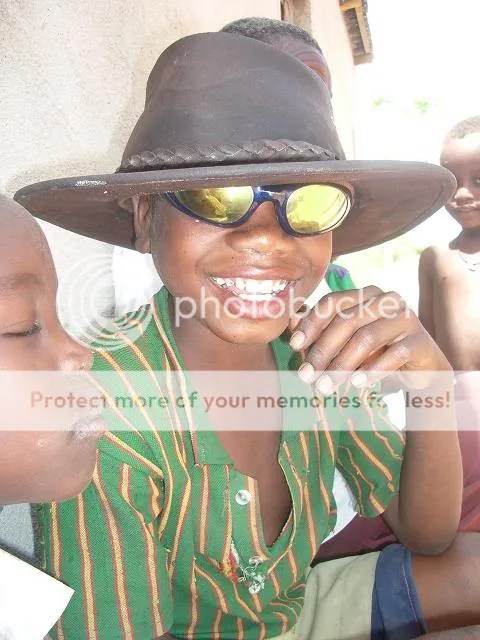
A boy looking far better than I ever could in my hat and sunglasses.


Isiah and his family.


A class of mainly blind children.


Two boys who regularly played by our house.


John Kapingo from the rehab centre. The boy on the left is his eldest son Michael.


The wife of John Kapingo. They are both blind. The baby is their newborn son.


Some of the trees I planted in 1999. Others are much taller.


A local boy with his toy hoop.


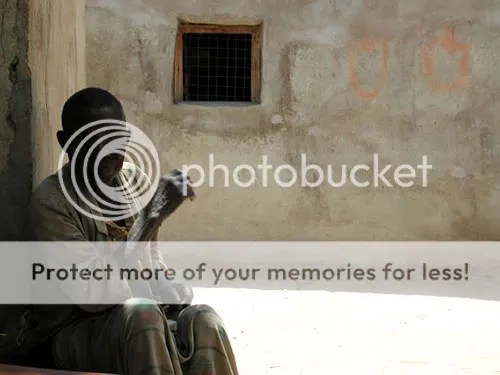
An old man from the rehabilitation centre (this is one of Will’s photos).


Posted in Uncategorized | Leave a comment